
How to Maintain Cultural Sensitivity in Localized Marketing Campaigns

Featured Image: freepik.com/vectorjuice
Have you ever wondered why your favorite brand has a different marketing campaign in another country? The obvious answer is that want to appeal to their regional audience. And that is mainly correct. But there is another, more in-depth reason behind it too. Brands create localized marketing campaigns for various audiences based on their cultural values and regional differences.
A commercial, jingle or social media campaign that is another language or features a local brand ambassador could have more relevance to local audiences. It also allows businesses to maintain cultural sensitivity in their marketing content.
Now, you may be thinking that only established brands like Nike, McDonald’s or Coca-Cola would be able to pull this off. Well, small businesses and startups can also go global by following a similar strategy. Let’s find out how!
What is Localized Marketing?
Simply put, this is when a brand’s core messaging, imagery, ambassadors, and sensory aspects are adapted to the preferences of local audiences or markets. For instance, brands like Nike, H&M, and KFC all have different branding strategies for various regions. If you think about it, their messaging in Europe resonates with their culture and is quite different from what you may see in North America.
Take a look at Nike’s campaign in countries like Malaysia, Indonesia, and the Middle East, where they appealed to audiences that were mostly Muslim.

Image Screenshot: Nike.com
The brand has successfully tapped into the local market by appealing to their culture. Not only is their campaign inclusive, but it also prioritizes cultural sensitivity while highlighting the message and product. And that’s what makes an impact.
While this is an example of a global corporation with a flexible marketing budget, it doesn’t mean that small business owners cannot achieve similar results. All you have to do is incorporate elements of another region’s culture in your marketing strategy and factor in the differences that could help your business scale.
One simple way to support global expansion is by using an eSIM card. It allows you to stay connected across countries without switching physical SIMs, making international business or travel easier and more efficient. Many countries now support eSIM technology, and with options like eSim in Thailand, travelers can stay connected without the hassle of swapping physical SIM cards.
Elements of a Successful Localized Marketing Campaigns
If you are wondering how you can attract regional or local audiences from a different country or culture, you have landing in the right place! Let’s delve into what makes a successful marketing campaign that is culturally sensitive.
Regional Languages
It is a good idea to address the local audiences in their language or add subtitles. For marketing materials like a professionally designed brochure or flyer, using a local language might seem obvious. But, sometimes, this may not be the case.
This is mainly because it’s easier to run the same campaigns in a universal language instead of choosing localized options. And language is usually an afterthought for brand, even when it comes to localized marketing campaigns. But if you want to appeal to culturally different audience, then it should one of the key aspects on your list.
People are likely to respond positively to commercials, print ads, social media posts or other marketing collateral that are in their native languages. They can easily understand the message and connect with it emotionally as well.
Relevant Brand Visuals
For your campaigns, you may also need to slightly modify your brand elements such as logos, colors, shapes or fonts. Now, I’m not saying brands need to have multiple variations for localized marketing campaigns, just that they should introduce minor changes for cultural sensitivity.
You need to consider that colors for instance can have various meanings in Eastern, Western or Middle Eastern countries. Take the example of red here and think about what it means. In the West, it symbolizes excitement and happiness, while in Middle East, it could mean danger or warning.
So for your localized marketing campaigns, it is important to introduce variations of your brand elements that will send the right message. The colors in your logo impact the way your brand is perceived and how people will react to a promotional ad or post.
Uber made a bold move with its rebranding campaign in 2016. For a more localized approach to its brand, the company introduced its app icon in different colors depending on the country. In the US, customers saw a bright turquoise color in the new icon, and in China, the colors changed to shades of red.

Image Source: logos-world.net/uber-logo
Smooth Accessibility
You may think that as the world has become completely globalized, that most people have access to digital media. While there are around 5.56 billion internet users, you cannot assume that everyone has an easy understanding of social media, emails, websites or apps. And this should show in your marketing campaigns when you are looking to maintain cultural sensitivity.
Some audiences may have limited or restricted internet access preventing them from accessing videos or social media apps like Instagram or X/Twitter. This could affect the reach of your localized marketing campaign.
It is important to make sure that digital media, your website included, supports smooth accessibility. Check if the platform loads in seconds, requires less bandwidth and has regional language options too. The goal is to keep things simple, perhaps designing an accessible website based on your target audience’s potential limitations.
Relatable Content
The key for an effective campaign is relatability. Once your audience connects with what you are trying to convey, they will likely respond with a positive feedback. Your content should be relatable and add aspects of the local culture. In China, brands have and continue to respect their culture by celebrating the new year and other similar festivals.
Similarly, companies can include yearly holidays or popular traditions in their localized marketing campaigns to attract potential customers and build a positive perception beforehand. This campaign by IKEA India is a great example of culturally relevant marketing that appeals to the local audience.
Product Add-ons
The process of localization goes beyond translation; it involves modifying your product to meet the preferences of the local population. For instance, in the food and beverages industry, it is imperative to understand the local dietary habits and culinary preferences. A restaurant’s success in a new market depends on the adaptation of its food and advertising to reflect the local culture and ingredients.
And you know who does it the best? McDonald’s. The brand truly nails its localized marketing campaign by expanding its menu to include food items that are loved by the people in the country. It has introduced the ‘Patatas Deluxe’ in Spain and keeps adding more options as well.

Image Source: mcdonalds.es
How to Ensure Cultural Sensitivity for Localized Marketing
Making a product, service, or content suitable for a new audience requires cultural sensitivity for localized marketing campaigns. The following are some key steps:
Make Sure You Hire Experts
Localization teams can benefit greatly from the expertise of cultural experts or consultants. Professionals with this expertise know the target culture’s nuances, norms, and sensitivities in depth. An expert cultural consultant could, for example, provide advice regarding the auspiciousness or offensiveness of certain symbols or colors.
Providing insights into the target culture’s history and sociopolitical context is the responsibility of cultural consultants. Localizers and translators will be able to understand the subtleties and references embedded in the content with this information. In localized marketing campaigns referencing historical events, cultural consultants can ensure that they are accurate and culturally appropriate.
Train People in Cultural Sensitivity
To develop a greater sense of cultural awareness, translators and localizers need cultural training. Training may address cultural dimensions like collectivism and individualism, as well as high-context and low-context communication, all of which have a dramatic impact on how content in localized marketing campaigns is created.
During training sessions, idiomatic expressions, humor, and etiquette should be emphasized. In Asian languages, for example, you should understand when and how to use honorifics, as well as how personal space is regarded in different cultural contexts.
Keep Learning
We live in a dynamic and ever-evolving world. It’s possible that what is considered culturally sensitive today will not be the case in the future. Translators and localizers should read cultural news and books to stay on top of cultural shifts. In this way, they ensure the relevance of their work.
Team members may gain a deeper understanding of a culture’s norms and values by immersing themselves in it. It is extremely beneficial to travel to the target country, take part in local events, or study the local language.
Avoid Using Stereotypes
The goal of inclusive language is to avoid stereotypical language, biases, or offensive words that may alienate or marginalize one’s audience. It is important for content to be respectful of diversity and to embrace it. Avoid stereotypical representations of people from different cultures or backgrounds when working on localized marketing campaigns.
It is important to translate and localize pronouns and titles according to an individual’s preferences. Choosing honorific titles and titles carefully is essential in certain cultures due to their importance.
Testing and Providing Feedback
A field test must be conducted after the translation and localization processes have been completed. You can use focus groups or surveys to gauge how your content is received by your target audience. Based on their feedback, it can be determined how well the content matches the local culture and if it needs to be adjusted.
Content should incorporate feedback received from the target audience. Localization becomes an iterative process as audience responses are incorporated into the revision process, making it increasingly culturally sensitive. Beyond qualitative feedback, brands can develop KPIs tied to localization goals — such as regional engagement rates, conversion lift, or sentiment trends — to measure whether cultural adaptation is improving campaign performance.
Engage in Collaboration
To achieve cultural sensitivity, collaboration is essential. Communication between creators, translators, and localizers must be transparent. Culture sensitivity issues can be addressed with regular meetings and discussions, resulting in better content.
Team up with cultural consultants, linguists, and subject matter experts to form cross-functional teams. Multi-perspective approaches within localized marketing campaigns ensure that a well-rounded and culturally sensitive result is achieved.
Maintain Compliance With the Law
Compliance with local laws and regulations is essential when translating and localizing content. To avoid potential pitfalls, such as violations of intellectual property rights or cultural insensitivity, it is recommended that the content be reviewed by legal experts familiar with the laws of the target country.
There are differences in privacy and data protection regulations between countries in the digital age. Observing these regulations is not only a legal requirement but also demonstrates respect for individual rights and the security of personal information.
Challenges in Achieving Cultural Sensitivity
Many factors and obstacles can hamper cultural sensitivity for localized marketing campaigns, and these factors and obstacles may be different for each project and target culture. Here are a few common ones:
Cultures of Diverse Origins
Culture presents itself in numerous ways throughout the world through various beliefs and multiple traditions. Achieving harmony by honoring various cultural differences turns out to be difficult when creators need to formulate messages that work for everyone.
Some cultural norms do not exist in particular cultural settings. Maintaining consistency during translation proves to be an exceptionally difficult task for translators and localizers who need to respect cultural differences.
The nature of cultures is dynamic since they consistently transform through time. Social, political, and economic changes create new interpretations of specific subjects and symbols. The work of translators and localizers requires knowledge about ongoing cultural changes to maintain sensitivity in content material.
The way cultural sensitivity appears to different generations in the same cultural group can vary. Older generation standards differ from the standards established by younger generations. The management of conflicting viewpoints between generations proves to be a difficult task.
Royal Carribean Cruise partnered up with GoodRebels to create a memorable localized marketing campaign on their social media. Their accounts for European countries sent out localized messages for Mother’s Day with popular phrases used among local audiences. While this worked for the brand, it might be a challenge to pull off for smaller businesses with limited resources.
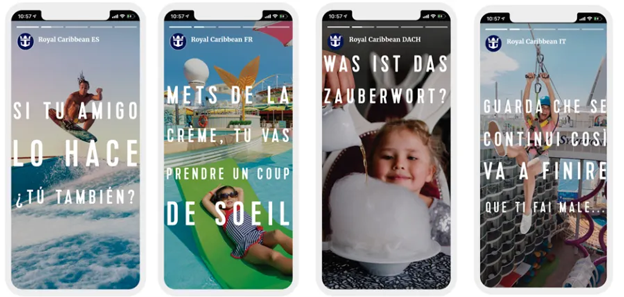
Image Screenshot: goodrebels.com
Differences Between Languages
The same language contains distinct dialects and regional variations that exist independently from one another. The selection of language variants rests with the translator, who uses demo-specific nuances.
The language contains various jargon and slang elements that exhibit significant differences across its regions. The successful implementation of these expressions depends on both appropriate usage and correct application in localized content.
Bias Implicit in Decisions
Cultural biases unknowingly enter localization work through the actions of localization specialists. Content translation and localization processes may become affected by the existing biases, which leads to potential cultural insensitivity issues. Continued efforts are needed to both identify and solve biases that exist within localization processes.
The cultural sensitivities between source and target cultures may differ from one another. Special training, along with deliberate thought processes, results in achieving harmony between cultures.
Conclusion
These are just a few things to keep in mind for cultural sensitivity in localized marketing campaigns. Translation and localization should be culturally sensitive to bridge language barriers, foster trust, and build positive global relationships. We’ve learned that cultural sensitivity goes beyond linguistic ability and involves respect, understanding, and adaptability as well. Achieving success in this complex terrain requires organizations to embrace cultural expertise, provide continuous education, and encourage open communication.